Just a heads-up based on what I’ve gathered: if you sell your investment before your PR is granted, you’ll likely lose your GV eligibility—including the benefit of the reduced minimum stay requirements.
While the law might seem flexible in theory, the actual practice sounds stricter. I’ve been repeatedly advised to hold the investment as long as possible to avoid any ‘extra justification’ hurdles during renewals. Also, don’t forget that if you wait until you’re a Portuguese citizen to redeem, you could be hit with capital gains tax in both countries.
I’m still trying to get to the ‘actual truth’ here. Many law firms claim a 100% success rate across thousands of cases, but when you press them on renewal issues, they get vague. They’ll admit that problems come up—like family emergencies or the death of a main investor—and say they ‘worked through it,’ but they never provide the actual details. It makes me wonder what the real-world experience is like when things don’t go perfectly by the book.
The law explicitly states you must keep your investment for 5 years. It does not say anything else, i.e. it does not mention renewals, PR etc., only the term of 5 years full stop. How it is treated in practice by AIMA I do not know as I never sold 
I researched this a long time ago (as in just after we entered the GV programme) because I was concerned about what would happen to the family if the primary died along the way. This was the information provided by SEF at the time wrt family reunification under Art 98(1) of Lei 23/2007:
“Two years after the issue of the first residence permit and in as much as there are family ties or, regardless the mentioned deadline, whenever the holder of the right of family reunification has underage children living in Portugal, the members of the family have the right to an autonomous permit, valid for three years, and renewable, under the amendment introduced to article 75 of the Aliens Act, by article 192 of Act n.º 75-B/2020, of 31 december. The first residence permit granted to the spouse under the family reunification is autonomous whenever he/she is married for more than five years with the resident – valid for two years, renewable for three, under the amendment introduced to article 75 of the Aliens Act, by article 192 of Act n.º 75-B/2020, of 31 December.”
This aligns with what the European Commission’s Immigration Portal currently has on family reunification in Portugal:
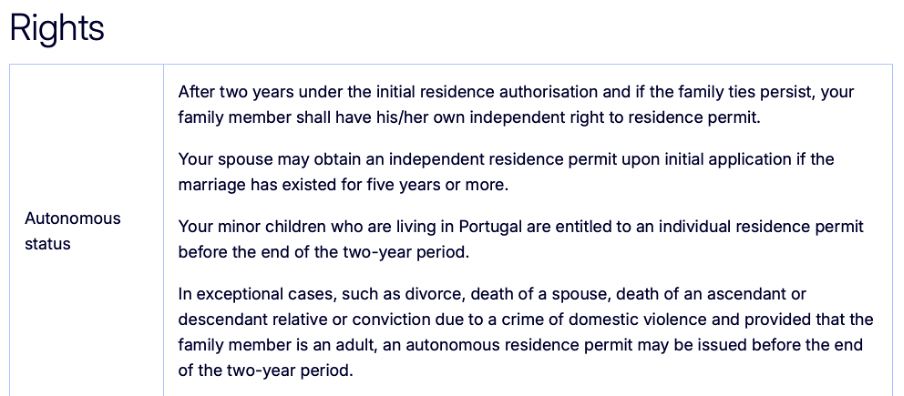
Family member in Portugal - Migration and Home Affairs (updated 1 April 2025)
I don’t know if anything has changed with the latest round of PT law reforms, but its worth knowing that European Council Directive 2003/86/EC on the right to family reunification sets a limit of no more than 5 years of residence as a family member after which member states must allow for autonomous residence (Art 15).
@Lala Just wanted to say a quick thank you for that detailed breakdown of the autonomous residence rules. Your explanation really cleared up how the transition from family reunification to independent status actually works.
It seems like EU laws are designed to prioritize individual rights and human dignity on paper, but as many of us have realized, the administrative reality in Portugal can be a different story. Especially with the Golden Visa journey, the process often feels more dictated by political shifts and bureaucratic hurdles than the law itself.
At the end of the day, when a family commits to this long-term path, the strategy has to be: prepare for the worst, stay patient, and hope for the best. Even when unexpected events pop up, don’t count yourself out—it’s worth hiring an experienced lawyer to present a strong legal argument. The bottom line is that the Portuguese economy can certainly still use a bit of investor money
1 Like
Definitely worth checking into, as last autumn’s Foreigners Law (not Nationality Law) changes did make family reunification more difficult, with some carve-outs for ARI and “highly qualified professionals.”
Thanks. Looking back over your posts on the subject, I just want to respond to one claim:
I don’t think it’s correct, as a rule, that if the primary is disqualified their family can essentially delink and continue independently. This could only happen in the exceptional circumstances like death, divorce, and conviction for domestic violence. As a rule, even if family members have reached the stage of holding autonomous residency, their renewals remain conditional and can still legally be tied to the same conditions applied to the primary. This is true for other residency categories as well. If I’m correct, this means that if the primary is disqualified while holding a GV, their family would also be disqualified. However, once they are out of the GV their family is also no longer subject to the GV conditions and becomes subject only to the general renewal conditions.
Good luck finding an experienced immigration lawyer. That is not a topic you want to draw me out on.