Thank you all above for your responses.
Of course we cannot do EdPro until we have processing started-
We will be in Lisboa in April/ May for some intensive beginners classes at LUSA. If I get a chance to speak to our legal team then, I will ask for clarification.
They’re unlikely to change it for existing citizenship applications, but GV holders who haven’t already submitted are fair game.
1 Like
Great short video on the experience of taking the A2 Ciple exam. Very similar to my own experience. Good luck to those of you sitting the exam soon.

I sat for the A2 last week. I did it in Rome, and I think this was a good decision. The speaker quality was really good, and there were speakers throughout the room. So, I doubt there was a bad seat in the room for hearing the audio tracks.
The proctors were very helpful and accommodating. There was a decent amount of chaos, as you’d expect from a joint project of Portugal and Italy. But this mostly worked to the test taker’s advantage, with one exception–for some of us, we had to come back the next day to do the oral interactive part. And, at least for my group, there was no published schedule of when (roughly) our time slots would be, so there was no way for us to practice with our expected partners beforehand and it meant a lot of waiting around. In general, if someone said they needed to do their session early (to check out of a hotel room or catch a flight or train, for example), the proctors accommodated that. (If someone wants to know the various advantages, DM me. I don’t want to ruin it for any future test takers.)
As for the exam itself, I can definitely recommend the LEPO practice exams. They were almost identical in format and difficulty to the actual exam. The only big difference is that, for the oral comprehension part, in the actual exam, we had 30 seconds to read each of the questions before the audio tracks played. This was, of course, a pleasant surprise. Also, none of the practice exams I took (I probably took 20 from various sources) prepared me for the format (vs the content) of the oral interactive part. That part has 3 sections–introduction of yourself, describing a photo to the proctor and interaction with your partner to plan or do something. That much was expected. However, I wasn’t expecting so much interraction with the proctor. From the sample exams, I was expecting it to be all examinee-driven (unless there was a void, in which case the proctor would intervene to get things going again). Also, I wasn’t expecting to have paper to take notes on before starting the clock on the picture description, so I didn’t practice with that tool or use it effectively. (In the end, it would have been helpful because in the pressure of the moment, I confused morcego, morango and moreno when I was trying to say moreno.  )
)
One final note is that you will “need” both a blue ink pen and a pencil. I put “need” in quotes because the proctor clarified that it was “better” to do it this way but that either would work. The instructions on the exam are clear that the multiple choice part must be in pencil and the writing sample must be in pen. So, YMMV.
13 Likes
Ecxellent review. Thank you for added this to the knowledge base.
A post was merged into an existing topic: PGV / ARI Rage, Tragedy, & General Madness
Kevin, I sat it in the recent session too, in Macau. How did you find the listening? I found it very hard, as did everyone else in the room. I know this is common feedback but it is bizarre how out of sync it seems to be with the standard of the reading, writing and speaking sections. Someone mentioned to me that they’ve been told it’s used to differentiate between the average and the very good candidates - as you need to be pretty good at Portuguese in order to score highly in the listening sections.
Whether or not I pass is going to come down to whether I scored highly enough in the other sections to bring my average mark up to a pass!
1 Like
Here’s a link to the LEPO exams I mentioned in my review. It is a package of 4 exams. https://www.patreon.com/learneuropeanportugueseonline/shop/bundle-ciple-prep-mock-tests-volume-1-2-1437180?source=storefront
I also did the 2-3 official practice exams that my instructor had. Finally, I did the sample exams that LIDEL published in their book “Testes de Português, A1/A2”. (Sorry, I don’t have a link–I bought mine at the big Edward VII book fair.) That book has 20 exams, half of which are A1. The knowledge base there is the same, and they were useful to me, but the question formats were not as spot-on as the LIPO ones.
2 Likes
I struggle with that section too. My strategy was to do well enough on the written part (45% of the total points) and the oral interactive part (25%, IIRC) that it didn’t matter how well I did on that part. BUT, the sound quality in Rome was excellent. So, I can’t lay any blame there. In fact, that’s the entire reason I picked Rome, and it was even better than I expected.
1 Like
I have been looking for the 2026 CIPLE dates. Have they been published?
I don’t think so. (Which is a bit crazy since the first one will be in February, which seems just around the corner to me.) But, I think we can keep checking this site until it gets updated for 2026: Épocas de Exames - Centro de Avaliação de Português Língua Estrangeira . Maybe someone else has better info?
1 Like
Normally they are published in first weeks of January. At least that was the case last couple of years. Slots in Lisbon and Porto are being taken out pretty quickly, literally within several days. I booked one for myself around 2 weeks after the publishing, and for the summertime there were just couple of places in Portugal available… Had to do it in Braga.
1 Like
Yep, I agree that Lidel book with CAPLE practice tests is very good prep - I think everyone attempting A2 should try to get a copy.
I’d also recommend Compreensão Oral em Ação A1/A2 by Carla Oliveira, which has a lot of listening exercises that mimic the test that you can do on your own.
In my classes, we used a series of books by Ana Tavares called Português XXI. They’re really good but probably best used with a teacher.
I used this book for listening practice. I think it helped me improve my skills, however the listening in the exam was MUCH harder.
I agree. I did the exam in May and our listening was hard too. The thing people have to be aware of is that the audio samples for the test are usually real life situations (native speaker podcasts, friends speaking colloquially at normal speed with background noise from restaurant, public transport announcements over poor quality loudspeakers etc). They are not always sanitised studio recordings of actors talking slowly and clearly for an A2 learner.
The multiple choice questions test your ability to recognise A2 level info from the rapid speech of native speakers. And they also include some answer choices to trip you up eg. Luisa might say “I considered taking the train, but I’m going by car”, then one choice will be “Luisa is taking the train” to make sure you didn’t just hear “train” and misunderstand the core context.
I spent a lot of time listening to podcasts with native speakers (eg Portugueses no mundo), not to understand everything but to get used to hearing people speak normally, and that helped enormously.
5 Likes
I really don’t know how to help the future exam takers, but my outcomes from the exam in Braga summer this year are as follows:
- Reading was ok. I had 85% with 80-90% of preliminary tests results.
- Writing was not good for me - 59%, though I myself thought I did ok. Maybe the reason is that I probably just wrote in Spanish with Portuguese accent…
- Listening was awful, noisy and very difficult to understand. By some luck I have 80% in this portion, but that’s pure luck
- Talking was the most challenging part for me, since I never been in the Portuguese environment for a long time, and frankly I’ve never spoken Portuguese outside of the classes… However I had a great co-student with me, who did the most of the job, while I just asked him the right questions at the right time, and I got 79%
Portuguese is not that difficult for a starter, specifically for people who had Spanish in their background. I definitely recommend doing the exam not the 4-5 months classes.
Those are superb marks, congrats! 80% in the listening is awesome. My friend’s husband calculated the likely mark in the listening if you gave random answers and it was about 24% I think from memory. So you can’t get 80% through luck!
In my case I’m really hoping to have scraped 25% in the listening (which I understand is the minimum pass mark for each section, with 55% overall required to pass) - I feel like I knew very few of the answers. And then I’m hoping to have scored highly enough in the other sections to pass overall. I think my Reading was probably quite good, but I feel like I only did “average” in speaking and writing, so not sure it will have been enough to pass overall.
1 Like
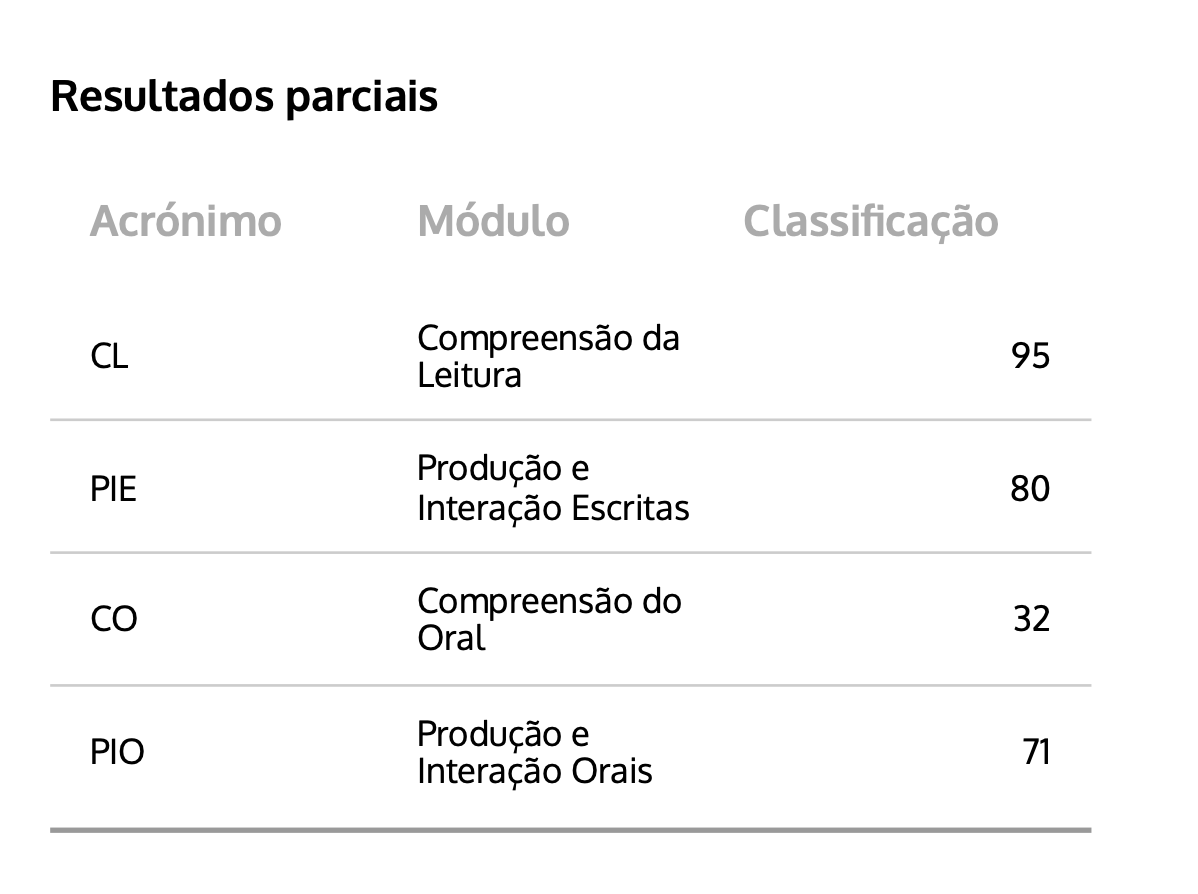
Guys, one question. One can take just one exam per epoca. In this case, is epoca a calendar year or a specific month? My son is registered to pass the exam in March, but I have some doubts he will pass. Will he be able to register again to the later exam this year if the result of this one is negative, or we’ll have to wait till next year?
By the way, yesterday night there were slots in Lisbon for March.
The época means the month in my experience. I once successfully registered both A2 and B1 exams with one day apart in Nov 2023. A week or 2 later, the test center wrote me an email asking to only select one and also informing the fee is not refundable.
In 2024, I registered two B1 exams, one in May and another one in July. There was not problem with these registration.
1 Like